
Agent Guides
Based on the HAR MLS Rules dated June 8, 2026.
Short answer: For a gated community, send the photographer the gate code or get them on the guard's visitor list before the shoot, and never put access codes in public remarks, which HAR Rule 1.2(b) prohibits. For a high-rise, call building management at least three business days ahead to register the vendor, reserve the elevator and parking, request the certificate of insurance the building requires, and get permission for any amenity or drone photos.
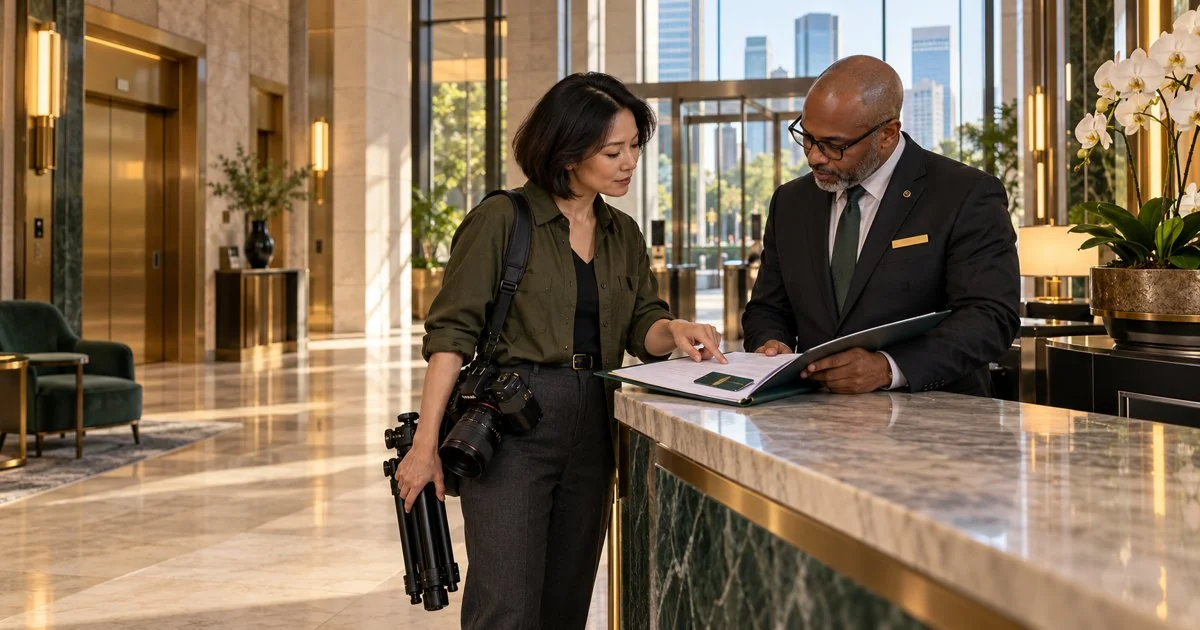
Most shoots that go wrong in River Oaks, the Galleria or a gated section of The Woodlands don’t go wrong at the camera. They go wrong at the gate, the concierge desk or the loading dock. A photographer who waits 40 minutes for a guard to reach the seller loses the light, and a high-rise that never received the insurance certificate can turn the shoot away at the elevator. Here’s how to clear every checkpoint before the appointment.
The access checklist
| Item | Applies to | Who handles it | Lead time |
|---|---|---|---|
| Gate code or guard visitor list | Gated | Agent or seller | Day before |
| Callbox name or unit number | High-rise, some gated | Agent | Day before |
| Vendor registration with management or concierge | High-rise | Agent or seller | 3 or more business days |
| Certificate of insurance | High-rise, some HOAs | Photographer, sent to management | 3 or more business days |
| Elevator, dock or parking reservation | High-rise | Agent or seller | 3 or more business days |
| Amenity photo permission | Both | Agent asks HOA or management | Before booking |
| Drone launch permission | Both | Pilot asks HOA or management | Before booking |
| Unit access: key, seller or agent on site | Both | Agent | Day before |
Gated communities
- Know which kind of gate it is. A keypad gate needs a code. A staffed guard house needs the photographer’s name on the visitor list, sometimes with a license plate. Some communities use an app where the resident issues a one-time pass, which only the seller can do.
- Send the code privately. HAR Rule 1.2(b) bars confidential information such as showing instructions and security codes from public remarks. The Showing Instructions field isn’t shown to buyers (Rule 12.1), so access details for members go there. Your photographer isn’t an MLS member, so text them the code.
- Check the HOA’s vendor and drone rules. Some associations restrict commercial vehicles, contractor hours or drone launches from common areas. A launch from the listing’s own lot requires the seller’s permission and a check of applicable property restrictions, airspace and flight-safety rules.
- Photograph the amenities that help sell the home: the clubhouse, pool, trails or lake. Rule 1.25.5 allows the property’s immediate vicinity, as long as the listing stays the main subject. Keep residents out of frame.
- Get the entrance on a clear day. A good entrance or guard house photo tells buyers “gated” faster than any remark.
High-rises and mid-rises
Buildings run on rules, and each one has its own. Call management or the concierge as soon as the shoot is booked and ask:
- Does the photographer need to register as a vendor? Get the name of the person to send it to and any form they use.
- Is a certificate of insurance required? If so, get the exact certificate holder and additional insured wording, the coverage amounts, and where to send it.
- Which elevator and entrance? Some buildings route vendors through a service elevator or loading dock, sometimes only during set hours.
- Where can the photographer park? Visitor spaces, validation or a dock reservation. Downtown and Galleria street parking won’t hold a 90-minute shoot.
- Can we photograph the amenities? The pool deck, gym, lobby and roof terrace often need management’s OK and may be limited to quiet hours.
- Are there rules for drones or the roof? Roof access is almost always restricted.
Certificates of insurance, explained
A certificate of insurance (COI) is a one-page summary from the photographer’s insurer showing their liability coverage. Buildings use it to check the vendor’s stated coverage before allowing work. A certificate is evidence of insurance, not a guarantee that a particular claim is covered or a substitute for the policy and any required endorsements.
- Certificate holder: usually the association or the management company, spelled exactly the way management gives it.
- Additional insured: many buildings want to be named on the photographer’s policy, not just listed as the holder. Additional insured status requires the applicable policy wording or endorsement; listing a building as certificate holder alone does not grant that status. Allow time for the insurer to confirm the requirement.
- Coverage amounts: each building sets its own. General liability of $1 million per occurrence is a common request. Some also ask for workers’ compensation or a waiver of subrogation.
- Timing: request the building’s requirements when you book, not the day before. Incorrect certificate details can delay vendor approval or prevent access.
Drone flights are a separate question. General liability policies often exclude aircraft, so a building that allows a drone flight may ask for proof of drone liability coverage too.
Shooting the unit itself
- The view sells the unit. Interiors and the view are blended so both look right, and a twilight session often makes the strongest primary photo for a skyline view (see best time of day to photograph a Houston listing).
- Clean the glass. Floor-to-ceiling windows show every fingerprint. Ask the seller to clean inside, and check whether the building’s exterior window washing is on the calendar.
- Balconies: clear them completely. Wind on upper floors moves anything left out.
- Show it as it is. Rule 1.25.5 requires images to show the property in its as-is condition. Removing a neighboring building or a construction crane from the view alters the property, which triggers HAR’s watermark rule and keeps that image out of the primary spot (Rule 1.25.1).
- Label the shared spaces. Put “Building pool” or “Community clubhouse” in the Photo Description so buyers know what’s private and what’s shared. Captions can’t include contact information or incentives (Rule 1.25.1).
Drones at high-rises and gated communities
FAA rules cap most flights at 400 feet above ground, but a drone may fly higher if it stays within 400 feet of a structure and no more than 400 feet above its top (14 CFR § 107.51). That makes aerials of a tower possible, but three other things decide whether the flight happens: airspace authorization (much of central Houston needs it), the building’s permission to launch from its property, and the rules for operations over people. Flights over people not directly participating require a qualifying operation under FAA rules or an applicable waiver; otherwise the pilot must keep the flight clear of them (§ 107.39). For airspace, see flying drones over Houston listings.
Keys and lockboxes
PRO360 Photos holds its own HAR-issued Supra eKEY, so the listing agent only needs to authorize our access for the appointment.
HAR Rule 6.2 says a Supra key can’t be loaned or shared with anyone other than the key holder. HAR lists fines of $500 for a first offense, $1,000 for a second and revocation of the key for a third. Handing your key to a photographer isn’t a shortcut. Meet them at the door, have the seller let them in, or arrange a seller-approved physical key or combination lockbox. In high-rises, the concierge often holds a key, but only if the owner has authorized it in writing with the building.
Day-of plan
- Confirm access the afternoon before: code, visitor list, COI received, elevator booked.
- Send the photographer the unit number, the building contact’s name and a phone number for whoever can open the door.
- Prep the unit (see the seller prep checklist).
- Allow extra time. In a large building, getting from the garage to the unit can take 15 minutes.
How PRO360 Photos handles access
- Tell us at booking. Note the gate type, building name and management contact in your order so we can confirm access ahead of time.
- Insured for the work. PRO360 carries general liability insurance and separate drone liability insurance, and sends a certificate of insurance directly to building management on request. Send the building’s requirements when you book, at least 1 to 3 business days before the shoot.
- Drone flights by an FAA Part 107 certified pilot with drone liability coverage, with airspace authorization handled before the shoot.
- Seven days a week, same price. Weekend shoots help when weekday access is tight, as long as the building allows vendors on weekends.
- Next-morning delivery. Listing photos arrive by 9 a.m. the morning after the shoot.
- Access delays. We wait 15 minutes at no charge. After that, a one-time $25 waiting fee applies if the shoot goes ahead. After 30 minutes without access, it counts as a cancellation on arrival: $150 or the order total, whichever is lower (see our booking policy).
Explore our Houston real estate photography services. Planning the set? Read how many listing photos you need and HAR listing media rules, explained, compare packages, or book a shoot.
Frequently asked questions
Can I put the gate code in my HAR listing?
Not in public remarks. HAR Rule 1.2(b) bars confidential information such as showing instructions and security codes from public remarks. Showing instructions are not displayed to buyers under Rule 12.1, so access details belong there, and you send the code to your photographer directly.
Can my photographer use my Supra key to get into the listing?
No. HAR Rule 6.2 says a Supra key can't be loaned or shared with anyone other than the key holder, with fines of $500 for a first offense, $1,000 for a second and revocation for a third. Meet the photographer, have the seller let them in, or arrange a seller-approved physical key or combination lockbox. PRO360 Photos holds its own HAR-issued Supra eKEY, so the listing agent only needs to authorize our access for the appointment.
What is a certificate of insurance for a photo shoot?
A one-page form from the photographer's insurer showing their liability coverage. High-rises often require one before a vendor can work in the building, usually naming the association or management company as certificate holder or additional insured.
Can I include photos of the building pool or gym in a condo listing?
Usually yes. HAR Rule 1.25.5 lets images include the property's immediate vicinity, and condo amenities are part of what the buyer gets. Ask management first, keep residents out of frame, and say what the amenity is in the Photo Description.
Can a drone fly at a Houston high-rise?
Sometimes. FAA rules let a drone fly higher than 400 feet above ground if it stays within 400 feet of a structure and no more than 400 feet above its top (14 CFR 107.51). Many high-rises sit in controlled airspace that needs FAA authorization, and launching from the building's property needs management's permission.
How far ahead should I book a high-rise shoot?
Give the building at least three business days for vendor registration, the insurance certificate and an elevator or parking reservation, unless management confirms a shorter lead time.
Sources
- HAR MLS Rules and Regulations, dated June 8, 2026 (Rules 1.2, 1.25.1, 1.25.5, 6.2, 12.1)
- HAR: Top MLS Rules to Remember, revised April 21, 2025
- FAA: Operations Over People
- 14 CFR Part 107 (Sections 107.39 and 107.51)